


What Is Captcha? Everything You Need To Know About Captcha
What Is Captcha? You’re likely to have encountered a captcha when you use the Internet. It appears whenever you post a comment, make an account, or sign in to a website. It seems absurd that a robot asks you to prove you are human. Then suddenly, you are frustrated by the puzzles. These enigmatic puzzles are so crucial to solving when surfing the internet. We have covered everything you need about Captcha.
A brief history
It is not clear who was the first person to use captcha codes. One side is the AltaVista group, who created it in 1997. They were then implemented in its search engine to stop bots from using them. This research group’s method was made a reality in 1998 with the publication of a Patent.
A similar system was developed years later by a Carnegie Mellon University research team (Pittsburgh) in 2003. They called it a captcha. What exactly is a captcha, you ask?
What is Captcha?
Captcha is an authentication test that verifies that an online form was submitted by a human and not a program. It is designed to prevent bots, automated sweepstakes entry systems, hackers, or other automated logins from using the system.
What is the secret to the name’s amusing origin? CAPTCHA stands for “Completely Automated Public Turing Testing to Tell Computers and People Apart .”
Captchas can be useful in many situations. Captchas prevent hackers from trying to “brute force assaults”, in which they attempt every possible combination of passwords to gain access to accounts. They protect against fake votes and fraudulent sweepstakes entries.

Types Of Captcha
Captcha Image
Text-based CAPTCHAs are being phased out in favor of these. Image-based CAPTCHAs make use of prominent graphic elements like animals, shapes, and scenery. Captchas typically ask users to identify pictures that aren’t compatible with the subject or select images that match that subject.
Audio Captcha
Audio Captchas are an optional feature that allows people with disabilities to have access to information. These can be used with either image-based Captchas or text-based Captchas. These Captchas record an audio recording of the sequence of letters or digits that a user has submitted at that moment.
Text-based Captcha
Text-based captchas were the original way to check people. These CAPTCHAs can contain well-known phrases and words as well as random combinations of letters or digits. CAPTCHAs that are content-based may also allow for capitalization variations. These characters are presented in an unusual manner by the CAPTCHA, which necessitates translation. You can alter, rotate, or scale characters. You can also cover characters with realistic elements like dots, arcs and lines, background noise, or colour.
No Captcha/ReCaptcha
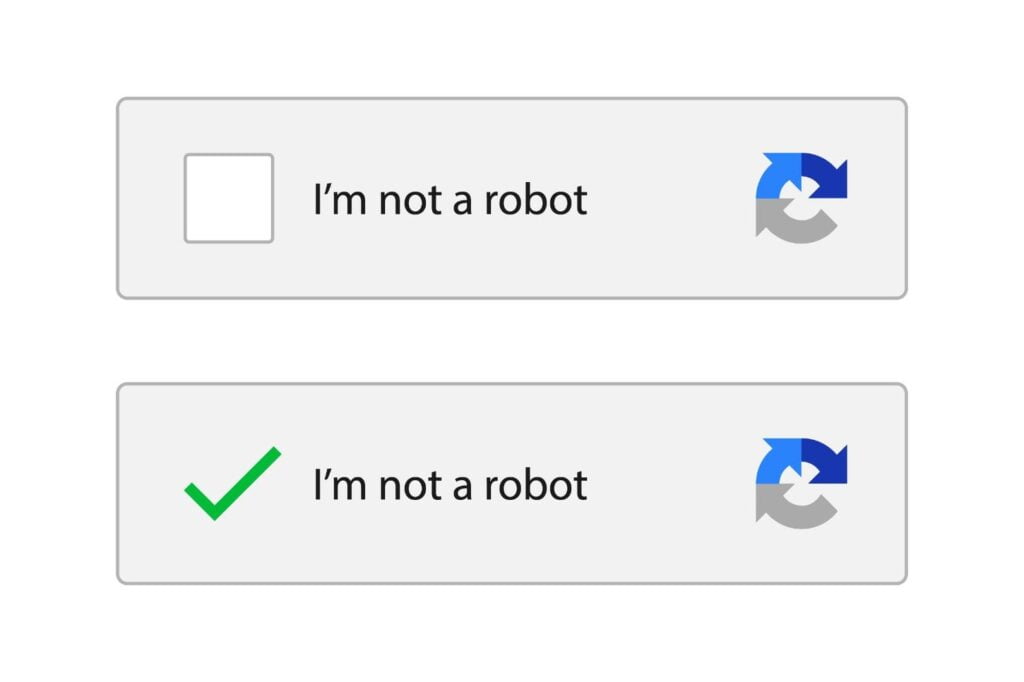
Google’s adoption means that no captcha and ReCaptcha are more easy for users than other types. It provides a checkbox saying “I’m no robot”, which clients must select. That’s all.
Social Media Sign in Captcha
Contrary to captcha, users must sign in with a social profile, such as Facebook, Google, or Linkedin. The single sign-on feature on social media sites will automatically fill in the user’s details.
Word and Math Problems
Visitors are required to solve simple math captcha or word problems. The assumption is that the bot will have difficulty identifying the question and formulating a response. A word problem asks customers to fill in missing words in sentences or complete related terms.
How Does Captcha Work?
How does the CAPTCHA code work? Many websites offer sections where you can register, fill in a contact form or leave feedback and reviews. Although users can interact with each page, bots may not be able to do so. A CAPTCHA code is most useful when you want to stop bots from leaving spam comments. This is not the only situation.
Other ways CAPTCHAs can improve security on a site are also possible. By securing accesses. It is often requested that CAPTCHAs be added to the site’s access pages. After you have entered your access information, Captcha will allow you to verify that you are who you say you are.
Even though a bot attempts to access it using an email address or password, it will not be able to verify the Captcha. The same happens when you try to change a password or register for it.
The existence of the captcha codes in all these cases prevents unauthorized access and ensures that the activities are performed by a human being.
It is, therefore, crucial to use CAPTCHA as part of a larger plan for keeping your site secure. As artificial intelligence advances, bots are becoming more difficult to defeat. Consequently, robots have developed new and more efficient ways to defeat bots.
Drawbacks of Captcha
CAPTCHA is a security feature that is often used but can sometimes be a bit annoying. It can be tedious to type strangely shaped letters and complete other types of challenges repeatedly. We get it, and programmers do use it. It seems like they are trying to delegate their duties to you. That would be partly true. Although there is truth to this statement, it is difficult to find another way. While advanced algorithms are possible, they can be easily fooled.
Accessibility is another problem. Even if your eyesight is excellent, there may be times when you experience difficulty seeing. It can be difficult to recognize a legitimate image or text (select Image Captchas). What happens if your vision is blurred or you have an eye condition? Although the audio version seems to be the best option, it can often be of poor quality. What if you don’t have a soundcard or only use text-based browsers?
Captcha can take up a lot time. Although it takes only 2,3 seconds, it’s used by all websites. What number of websites do you visit each day? What are the steps a website may ask you to take to prove your humanity to others?
Captchas can make your website less usable and more difficult to navigate. Google’s new ReCaptcha solution solves the problem but not all systems are capable.

Conclusion
There seems to be no one solution. For every generation of Captcha, there are new bots. They learn faster the more sophisticated algorithms you use to protect them. Does this mean that a captcha can be useless or only serve to frustrate users? The concept is sound. Even simple captchas can be a significant hurdle for most bots. It is not our intention to take it away, but remember that Captcha doesn’t protect you and your users against data/credentials leakage which can be caused either by browser extensions or third-party scripts.
Also Read-